Rescue Proves USVs’ Readiness for High-Stakes Operations
An unmanned vessel rescuing downed aviators in the Strait of Hormuz—and a reported $9.3B valuation—signals autonomous surface systems are enterprise-ready.
Executive Summary
An unmanned surface vessel reportedly executed a successful search-and-rescue in the Strait of Hormuz, demonstrating operational maturity under pressure. Combined with a reported multi-billion valuation for the manufacturer, the signal is that maritime autonomy is enterprise-ready. The opportunity spans port logistics, offshore energy, incident response, and environmental monitoring. Leaders should pilot outcome-based service models, stand up an autonomy data stack, and align governance, safety, and cyber from day one.
- ▸A real-world USV rescue signals autonomy is operationally ready.
- ▸Outcome-based RaaS contracts can align cost with measurable results.
- ▸Build an autonomy data stack: edge inference, MLOps, and observability.
- ▸Prioritize governance: safety cases, cyber hardening, and audit trails.
- ▸Early movers will capture data moats and resilience advantages.
Why this matters now
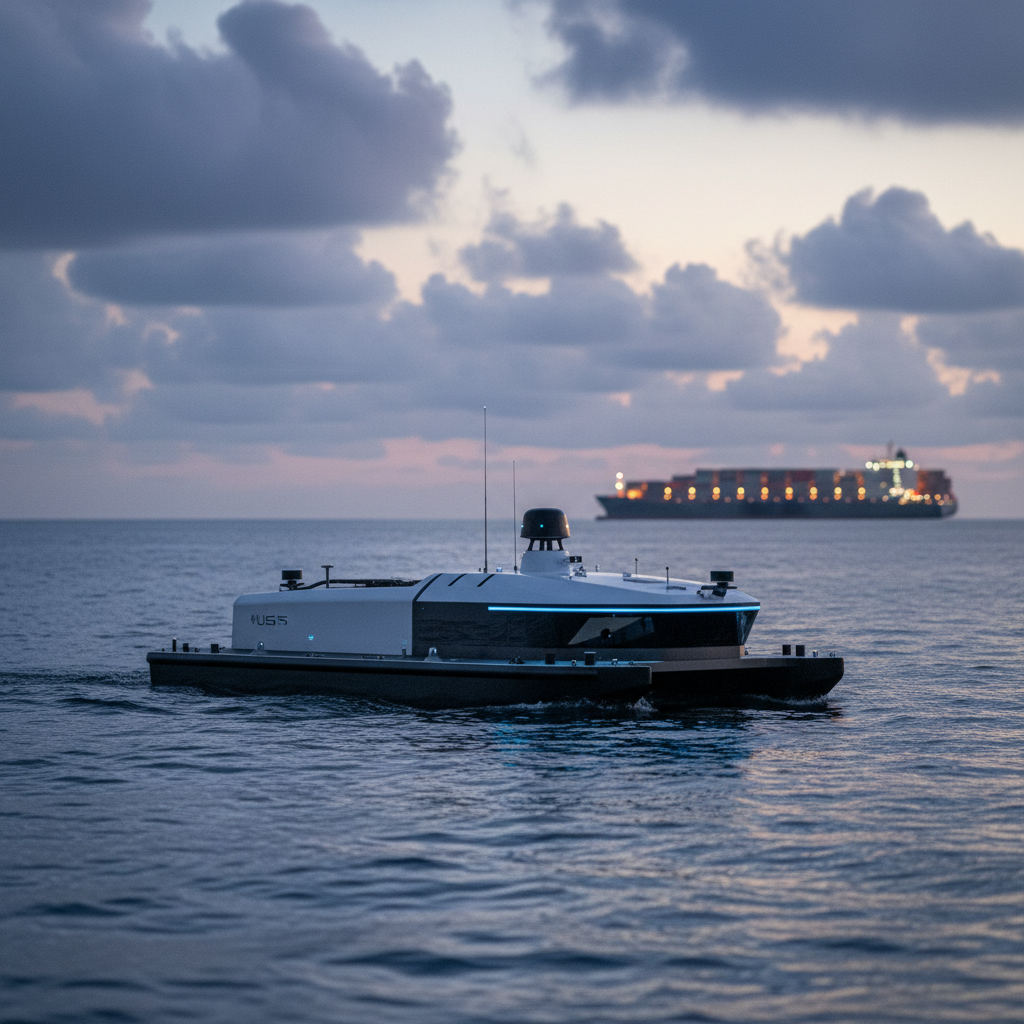
In a high-visibility test of unmanned maritime capability, an autonomous surface craft reportedly recovered two downed aviators in the Strait of Hormuz. The vessel, identified in reports as Saronic’s Corsair, executed a real-world search-and-rescue under operational pressure—not a staged demo. Paired with the startup’s reported multi-billion-dollar valuation, the signal is clear: autonomous surface systems are moving from pilots to high-stakes deployment. For non-defense enterprises, this milestone accelerates the case for autonomy, edge AI, and remote operations in harsh, distributed, and time-critical environments.
What it signals for enterprises
- Reliability threshold crossed: A successful search-and-rescue is among the most demanding use cases—dynamic conditions, human safety, and narrow response windows. That an unmanned surface vessel (USV) met the moment indicates system resilience, robust autonomy stacks, and effective human-on-the-loop control.
- Multidomain momentum: As with warehouse robotics, delivery drones, and autonomous mining fleets, the pattern is familiar—niche successes pave the way to broad operationalization. Expect rapid spillover into port logistics, offshore energy support, environmental monitoring, and incident response.
- Capital intensity and confidence: A reported valuation near the top tier for autonomy startups suggests investors expect platform economics, recurring services, and dual-use demand. Enterprises should prepare for rapidly evolving vendor capabilities and consolidation.
Business models and integration playbook
- From CapEx to outcomes: Robots-as-a-Service (RaaS) and mission-as-a-service models can shift spend to OpEx while tying fees to availability, on-station time, or incident response metrics. Negotiate SLAs that map directly to business outcomes—response time, area coverage, or inspection throughput.
- Enterprise integration: Treat USVs as data-generating edge assets. Plan API-first integrations with port management systems, ERP, EAM/CMMS, and incident management workflows. Stream telemetry into your data lakehouse; expose events to SOC/NOC playbooks; and codify automated triggers (e.g., deploy-on-threshold for weather, spills, or AIS anomalies).
- Interoperability as leverage: Favor vendors that support open navigation and sensor standards, standardized message buses, and exportable mission logs. Interoperability reduces vendor lock-in and accelerates multi-fleet orchestration.
AI and data architecture considerations
- Edge-first autonomy: USVs rely on onboard inference for perception, navigation, and collision avoidance. Design for intermittent connectivity: use store-and-forward data strategies, prioritize critical telemetry, and enable local autonomy with safe fallback states.
- MLOps at sea: Establish pipelines for dataset curation (multimodal marine sensors), model versioning, and rollback. Instrument the fleet to detect drift (changing sea states, cluttered traffic lanes) and retrain with closed-loop feedback from field performance.
- Digital twins and simulation: Build mission simulators for route planning, SAR playbooks, and weather/traffic scenarios. Use twins to test software updates, validate safety cases, and rehearse multi-asset coordination.
- Command, control, and observability: Stand up remote operations centers with standardized dashboards, alerting, and audit trails. Implement role-based control, cryptographic identity for vehicles, and zero-trust patterns for command links.
Risk, governance, and compliance
- Regulatory readiness: Track evolving guidance on Maritime Autonomous Surface Ships (MASS), flag-state requirements, and port authority rules for unmanned operations. For dual-use assets, align export controls, sanctions screening, and end-use policies.
- Safety and assurance: Maintain human-on-the-loop oversight for high-risk missions. Document a defensible safety case: mission constraints, geofencing, escalation protocols, and post-incident review. Log all autonomy decisions to support explainability and insurer confidence.
- Cybersecurity: Harden the comms stack (SATCOM/LTE/mesh), sign software artifacts, and separate safety-critical and non-critical networks. Treat USVs as roaming IoT: continuous posture assessment, firmware integrity checks, and incident response runbooks specific to remote assets.
Cost, KPIs, and outcome measurement
- Value framing: Assess cost per nautical mile, operational availability, time-to-detect and time-to-respond, and inspection/coverage rates. Compare against crewed alternatives factoring fuel, labor exposure, and weather downtime.
- Quality of service: Track false positive/negative rates in detection tasks, autonomy disengagements, mean time between safe-state events, and mission completion rates under degraded comms.
CXO action agenda (next 12 months)
- Launch a lighthouse program in a controlled corridor: start with inspection, perimeter security, or environmental monitoring. Define strict success criteria and a clear path to scale.
- Build the autonomy operating fabric: data ingestion, model lifecycle management, secure C2, and operational analytics. Appoint a cross-functional autonomy steering group spanning operations, security, legal, and risk.
- Contract for outcomes: pilot RaaS terms with performance-based SLAs. Insist on telemetry access, API openness, and shared IP provisions for co-developed mission playbooks.
- Prepare the workforce: upskill mariners and port ops staff into autonomy supervisors, remote pilots, and fleet analysts. Integrate safety drills for mixed crewed/uncrewed environments.
Signals to watch
- Regulatory milestones: formalization of MASS guidelines and port procedures for unmanned entries/exits.
- Insurance stance: premium differentials and endorsements for autonomous assets as loss data accumulates.
- Connectivity economics: improvements in satellite and 5G maritime coverage that expand viable mission sets.
- Vendor maturity: multi-vessel swarming, standardized interfaces, and acquisition activity among primes and startups.
Bottom line
A real-world maritime rescue by an unmanned craft, coupled with a pronounced funding signal, marks a practical turning point. Autonomous surface systems are no longer experimental curiosities; they are becoming dependable instruments for safety, resilience, and operational leverage. Enterprises that move now—thoughtfully, with governance—will convert autonomy into measurable advantage while competitors are still prototyping.
Executive Perspective
I view this rescue as a line-crossing moment: a demanding, time-critical mission completed by an unmanned platform in one of the world’s most scrutinized waterways. That is the bar enterprises can trust—proven performance when conditions are messy, not just in controlled trials.
The playbook is familiar from other autonomy domains. Value accrues to those who operationalize faster: standardize the data fabric, contract for outcomes, and build governance that scales. If you can turn incident response, inspection, or perimeter coverage into software-defined, remotely supervised workflows, you will compress risk and cost curves ahead of peers.
What This Means for Organizations
Operationally, organizations will need to treat autonomous vessels as edge compute assets within the enterprise mesh: onboard inference, local decisioning, intermittent backhaul, and robust observability. That requires a dedicated autonomy ops function with clear handoffs to security, facilities, and business continuity teams.
Structurally, shift procurement toward Robotics-as-a-Service with performance SLAs. Create cross-functional autonomy councils to harmonize safety cases, legal exposure, and data rights. Workforce models must evolve—less deck-plate exposure, more remote supervision and analytics—while preserving domain expertise through targeted upskilling.
Strategic Impact
This development expands the feasible frontier for remote, risk-sensitive operations. Executives can now reframe critical processes—inspection, patrol, spill response—as scalable services orchestrated across fleets, rather than single-asset, crew-constrained tasks.
Strategically, autonomy becomes a lever for resilience: redundant coverage in severe weather, persistent monitoring without fatigue, and rapid surge capacity. It also creates new data moats—continuous, high-fidelity maritime telemetry that powers predictive models and better decisioning across the enterprise.
Operational Implications
Expect tighter integration between USV telemetry and enterprise systems: port management, EAM/CMMS, incident response, and SOC workflows. Build event-driven pipelines that can trigger autonomous dispatch, escalate to human operators, and document every decision for audit and insurance.
Codify safety governance: geofenced missions, human-on-the-loop escalation, and post-mission debriefs driven by mission logs. Implement zero-trust for command-and-control, signed software updates, and continuous posture monitoring of remote assets.
Future Outlook
Near term, anticipate rapid expansion of pilots in commercial ports and offshore facilities, with insurers and regulators shaping standardized procedures. Connectivity improvements and maturing autonomy stacks will broaden missions beyond inspection to persistent patrol and coordinated multi-vessel operations.
Over the medium term, expect consolidation and platformization—common control layers managing mixed fleets, outcome-based contracts, and deeper integration into enterprise data fabrics. Organizations that invest early in governance, data, and MLOps will scale with fewer friction points.
- • Shift spend from CapEx to OpEx with performance-backed autonomy services.
- • Integrate USVs into port, offshore, and incident-response workflows to reduce risk and labor exposure.
- • Use continuous maritime telemetry to improve predictive maintenance and insurance negotiations.
- • Prepare workforce transitions toward remote operations and autonomy supervision.
- • Edge AI must operate reliably with intermittent connectivity and safe-state fallbacks.
- • MLOps pipelines for sensor fusion and drift detection become core capabilities.
- • Digital twins and simulation accelerate safe deployment and software updates.
- • Explainable autonomy logs underpin assurance, audits, and insurer confidence.
This analysis was inspired by reporting from What to Know About Drone-Boat Maker Behind Iran Helicopter Crew Rescue. All analysis, commentary, and strategic perspective is original work by Geraldine Vilato.